

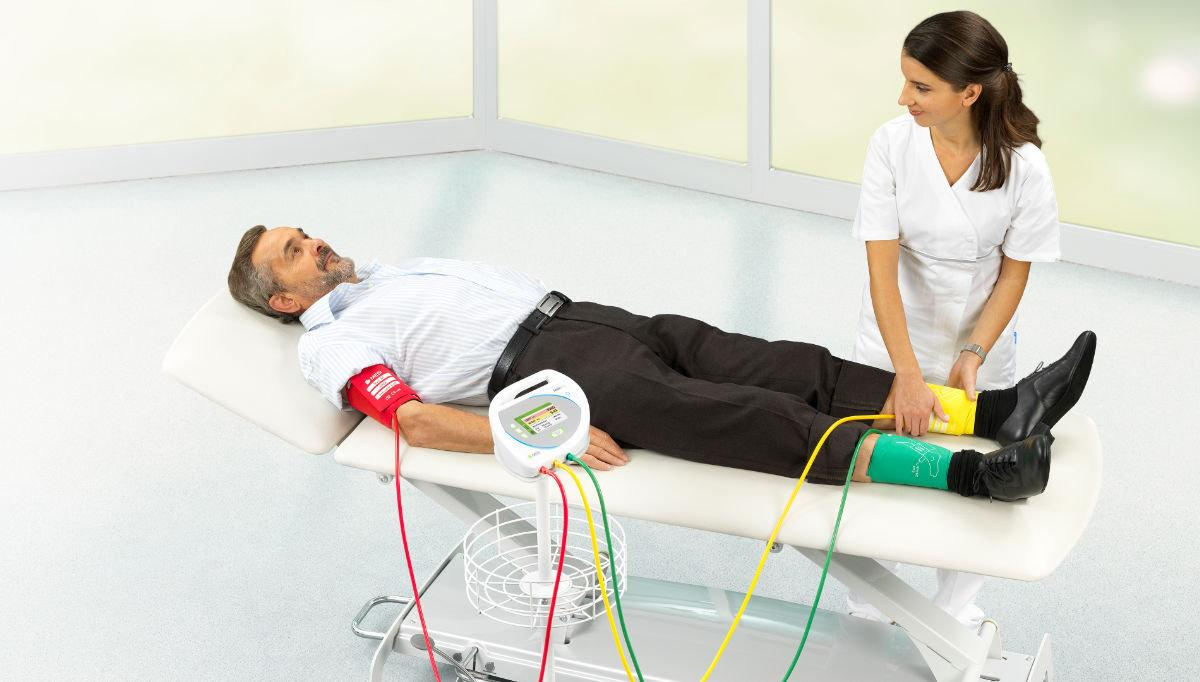
Ankle-Brachial Index (ABI) & Pulse Wave Velocity (PWV) A painless, non-invasive vascular assessment that evaluates circulation to the legs and arterial stiffness, supporting earlier detection and personalised cardiovascular prevention.
An Ankle-Brachial Index (ABI) and Pulse Wave Velocity (PWV) assessment is a painless, non-invasive test that evaluates blood flow to the legs and arterial stiffness. At Cardiology Center Zacharias Kounnis in Limassol, results are interpreted alongside your symptoms, medical history and cardiovascular risk factors to support early detection and personalised cardiovascular prevention.
Although ABI and PWV are performed as part of the same vascular assessment, they measure different aspects of arterial health.
The Ankle-Brachial Index compares the blood pressure measured at the ankle with the blood pressure measured in the arm.
A lower-than-expected ABI may indicate narrowing or blockage in the arteries supplying the legs, known as peripheral arterial disease or PAD. PAD can reduce circulation to the lower limbs and is also associated with a higher overall risk of heart attack and stroke.
.png)
Pulse Wave Velocity measures how quickly a pressure wave travels through the arteries.
More flexible arteries generally allow the pulse wave to travel more slowly, while stiffer arteries usually transmit it more quickly. PWV therefore provides clinically useful information about arterial stiffness and vascular ageing.
The result must always be interpreted in relation to factors such as age, blood pressure, medical history and the measurement method used.
.png)
ABI and PWV provide complementary information.
ABI evaluates circulation to the legs and helps identify possible peripheral arterial disease. PWV evaluates the stiffness and elasticity of the arteries.
Together, they can help our cardiology team:
Neither test should be interpreted alone. Results are considered together with your symptoms, physical examination, blood pressure, cholesterol, blood sugar and other cardiovascular findings.
Your cardiologist may recommend this vascular assessment if you have:
It may also be used as part of preventive cardiology or to monitor how vascular health changes following treatment and lifestyle interventions.
.png)
You will normally be asked to rest quietly before the measurements begin. Blood pressure cuffs and non-invasive sensors are then used to record pressures and pulse-wave information from different areas of the body.
The examination:
After the measurements, the results are reviewed within the context of your overall cardiovascular health.
An abnormal ABI may suggest reduced blood flow caused by narrowing or blockage in the arteries of the legs. A higher PWV may indicate increased arterial stiffness.
However, an individual result does not automatically establish a diagnosis. Normal results do not exclude every vascular condition, particularly when symptoms or significant risk factors are present.
If necessary, your cardiologist may recommend further assessment, such as vascular ultrasound, blood tests, cardiac imaging or additional cardiovascular investigations.
The clinic will provide any instructions required for your appointment.
Unless specifically advised otherwise:
You may be advised to avoid strenuous exercise, smoking, caffeine or a large meal shortly before the examination to support consistent measurements.
No. ABI evaluates the relationship between blood pressure in the ankle and arm to assess circulation to the legs. PWV measures the speed of the arterial pulse wave to evaluate arterial stiffness.
The examination is non-invasive and generally painless. You may feel temporary pressure when the blood pressure cuffs inflate.
ABI can identify signs of reduced circulation in some people who have few or no obvious symptoms. The result must still be interpreted alongside risk factors, symptoms and clinical examination.
Vascular age is a way of describing how the condition and stiffness of the arteries compare with what may normally be expected for a person’s age. PWV can contribute to this assessment, but it should not be treated as a standalone diagnosis or exact prediction of future health.
Repeated measurements may help monitor changes in arterial stiffness and circulation over time. Results should be compared under appropriate measurement conditions and interpreted together with blood pressure, laboratory results and other clinical findings.
Look for a cardiologist who combines vascular measurements with a complete cardiovascular evaluation rather than interpreting one number in isolation. The assessment should consider your symptoms, medical history, medications and risk factors and provide clear recommendations for prevention, treatment or further testing.
Cardiology Center Zacharias Kounnis provides ABI and Pulse Wave Velocity assessment in Limassol as part of its personalised preventive and cardiovascular care services.
For patients searching for a cardiologist in Cyprus, our approach combines non-invasive vascular testing with clinical evaluation and evidence-based cardiovascular risk management.
Early vascular changes may develop before noticeable symptoms appear. An ABI and PWV assessment can provide useful information about leg circulation, arterial stiffness and your wider cardiovascular risk.
Contact Cardiology Center Zacharias Kounnis to schedule an appointment or ask whether ABI and Pulse Wave Velocity testing is appropriate for you.