

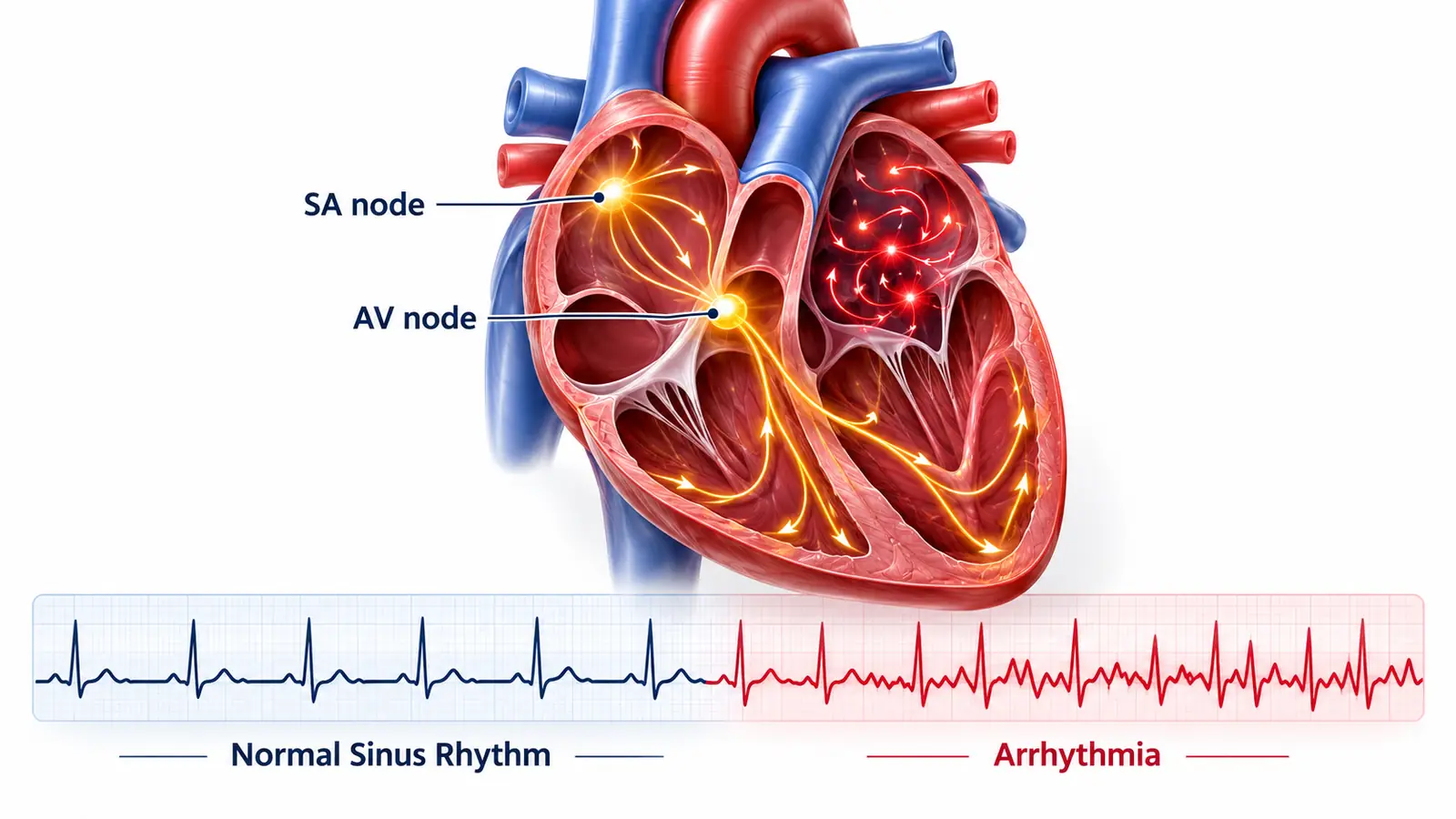
Using advanced diagnostic tools, we identify various types of arrhythmias (irregular heart rhythms) and develop personalized treatment plans that may include medication, lifestyle changes, or referral for procedures such as catheter ablation.
Accurate Diagnosis. Personalised Treatment. Confidence in Your Heart Rhythm.
Heart palpitations, a racing heartbeat, or an irregular pulse can be worrying. Although many heart rhythm disturbances are harmless, others may require careful investigation, treatment, or specialist assessment.
At Kounnis Zacharias Cardiology Center in Limassol, Cyprus, we provide comprehensive evaluation and management of cardiac arrhythmias, combining clinical experience, modern ECG monitoring technology, individualised treatment, and structured follow-up.
Our approach begins with an essential question:
What is happening to your heart rhythm when you experience symptoms?
Identifying the actual rhythm, understanding its clinical significance, and assessing your individual cardiovascular risk are the foundations of appropriate treatment.
A cardiac arrhythmia occurs when the electrical signals controlling the heartbeat produce an abnormally fast, slow, or irregular rhythm.
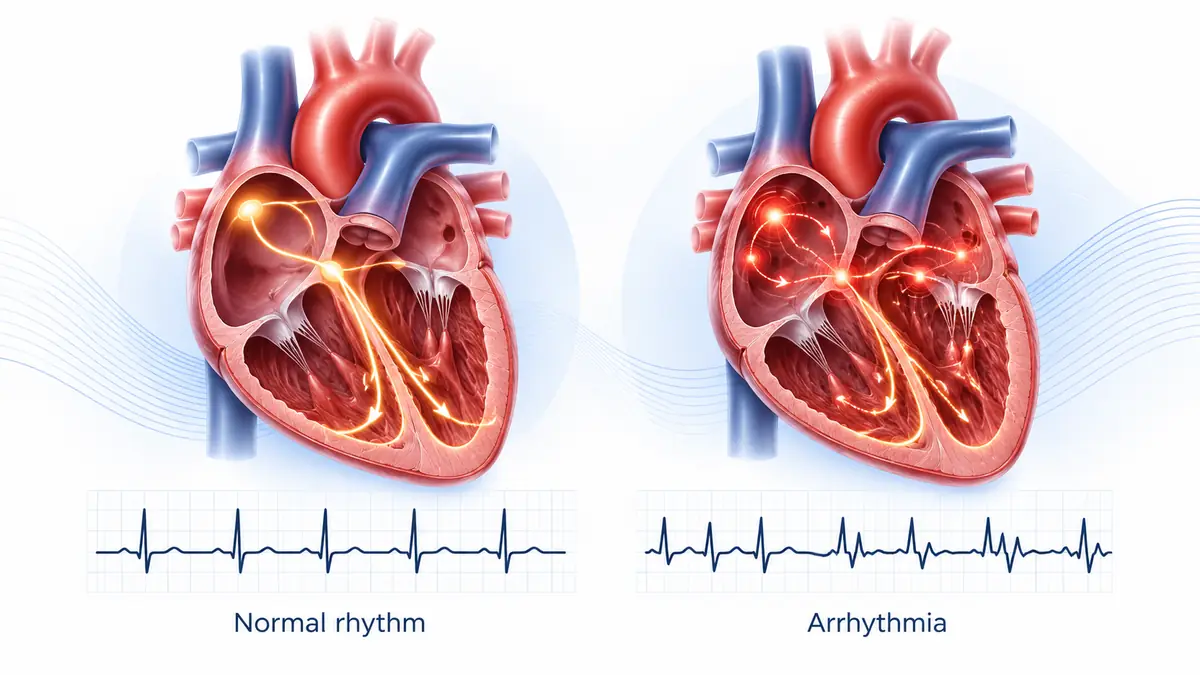
Common symptoms include:
Some arrhythmias cause no noticeable symptoms and are detected during a routine ECG or cardiac examination.
The significance of an arrhythmia depends on its type, frequency, associated symptoms, and the presence of underlying heart disease.
Every patient begins with a detailed medical history, clinical examination, and appropriate cardiac investigations.
We assess the characteristics of the symptoms, possible triggering factors, medications, family history, and previous cardiovascular conditions.
Particular attention is given to warning signs such as unexplained syncope, arrhythmias during physical activity, structural heart disease, and a family history of sudden cardiac death.
This allows us to distinguish low-risk rhythm disturbances from conditions requiring more urgent investigation or specialist intervention.
A standard 12-lead ECG provides important information about cardiac rhythm and electrical conduction.
However, intermittent arrhythmias may not appear during a routine consultation.
24–48-hour Holter ECG monitoring records the heart rhythm continuously during everyday activities and sleep, allowing us to investigate palpitations, abnormal heart rates, premature beats, and other rhythm disturbances.
Holter monitoring also helps evaluate selected treatment responses and quantify the frequency of certain arrhythmias.

One of the most valuable aspects of arrhythmia investigation is establishing symptom–ECG correlation.
This means determining whether the symptoms experienced by a patient actually coincide with changes in the electrical activity of the heart.
For selected patients, we offer the EMAY portable ECG monitor, a compact device that can be carried in a pocket.
When palpitations or other symptoms occur, patients can record an ECG and transmit it electronically to our Cardiology Center through a dedicated smartphone application.
This can be particularly helpful when symptoms are unpredictable and do not occur during conventional Holter monitoring.
Whether the patient is at home, at work, or travelling abroad, ECG recordings can be sent wherever suitable internet connectivity is available.
Once the recording has been reviewed, we can provide personalised guidance regarding the findings and appropriate next steps.
Our objective is not simply to hear about the symptoms, but to understand what the heart was actually doing when they occurred.
Remote ECG transmission also offers an important psychological benefit. Patients may feel more confident knowing they have a practical way to document symptoms and communicate with their cardiologist.
EMAY monitoring complements conventional investigations. Recordings are reviewed according to our clinical arrangements and do not constitute continuous emergency monitoring or guaranteed immediate medical response.
When appropriate, we perform echocardiography to assess cardiac structure, ventricular function, and valvular abnormalities.
Exercise stress testing may help investigate exertion-related symptoms or selected rhythm disturbances.
Blood tests may also be recommended to identify contributing factors such as thyroid disorders, anaemia, and electrolyte abnormalities.
The investigation plan is individualised according to each patient's clinical presentation.
Our Cardiology Center assesses a wide range of arrhythmias and related tachycardia syndromes.
Assessment of irregular heart rhythms, symptom management, heart rate or rhythm control, and stroke prevention, including anticoagulation when indicated.
Investigation of sudden episodes of rapid heartbeat, identification of the underlying rhythm, and individualised treatment or specialist referral.
Evaluation of skipped or extra heartbeats, their frequency, clinical significance, and the need for monitoring or treatment.
Assessment of posture-related increases in heart rate, dizziness, palpitations, and symptoms of orthostatic intolerance, with appropriate evaluation of heart rate and blood pressure responses.
Investigation of persistent or recurrent excessive sinus tachycardia, exclusion of secondary causes, and personalised symptom management.
Evaluation of heart rhythm disturbances in patients with coronary artery disease, previous myocardial infarction, myocardial ischaemia, or impaired ventricular function.
Assessment of unusually slow heart rhythms, suspected heart block, dizziness, and possible rhythm-related fainting.
Risk assessment and appropriate investigation of selected ventricular arrhythmias and conditions such as Wolff–Parkinson–White (WPW) pattern, with specialist referral when indicated.
For a general introduction, read Arrhythmias: When the Heart Loses Its Rhythm.
Not every arrhythmia requires medication or an invasive procedure.
Treatment decisions are based on the rhythm diagnosis, the patient's symptoms, cardiovascular risk, underlying medical conditions, and personal circumstances.
Depending on the findings, management may include:
When invasive treatment is appropriate, we coordinate referral to qualified electrophysiology specialists and remain involved in the patient's subsequent clinical care.
Effective arrhythmia management does not end when treatment is prescribed.
We reassess symptoms, heart rate, medication tolerance, ECG findings, and the patient's overall cardiovascular condition.
Repeat Holter monitoring, portable ECG recordings, or other investigations may be recommended when clinically appropriate.
Our aim is to ensure that treatment remains effective, safe, and suited to the patient's evolving needs.
We treat the patient, not simply the ECG tracing.
Our approach to heart rhythm disorders combines comprehensive clinical assessment with a strong commitment to personalised care.
We focus on four essential principles:
We recognise that palpitations and unpredictable rhythm disturbances can affect not only physical health but also emotional well-being.
Our responsibility is to help patients understand their condition, recognise important warning signs, and feel confident about their management plan.
No. Many palpitations are associated with benign premature beats or normal increases in heart rate. However, recurrent or unexplained symptoms should be assessed according to the patient's medical history and associated findings.
Yes. Intermittent arrhythmias may not be present during a routine ECG. Holter monitoring or a portable ECG device can help document the rhythm when symptoms occur.
A Holter monitor continuously records heart rhythm over a defined period, usually 24–48 hours at our centre. EMAY allows selected patients to activate an ECG recording when symptoms occur and transmit it electronically for subsequent clinical review.
Yes. Some rhythm disturbances require only reassurance, observation, or management of contributing factors. Treatment always depends on the diagnosis and individual cardiovascular risk.
Palpitations accompanied by fainting, severe chest pain, significant breathlessness, collapse, or other serious symptoms require immediate local emergency medical assessment rather than waiting for a routine appointment or remote ECG review.
If you experience recurrent palpitations, an irregular heartbeat, unexplained episodes of rapid heart rate, or have been diagnosed with a cardiac arrhythmia, an individualised cardiological evaluation can help determine the most appropriate next steps.
At Kounnis Zacharias Cardiology Center, our goal is to identify your rhythm disturbance, assess its significance, guide appropriate treatment, and support your long-term cardiovascular health.
Understand Your Rhythm. Know Your Risk. Protect Your Heart.
Book an Arrhythmia Consultation or call +357 25 389 696.
Kounnis Zacharias Cardiology Center, Limassol, Cyprus
Medical content reviewed by Dr. Zacharias Kounnis, Consultant Cardiologist, upon final clinical approval.